ccnp · 5 min read
9Tut ICND1 and ICND2 Premium Resources: Quizzes and Simulators
An orientation to the supplied 9Tut ICND1 and ICND2 premium resource pages, including topic quizzes, composite quizzes, new-question sections, and simulator navigation.
Updated 8/8/2026
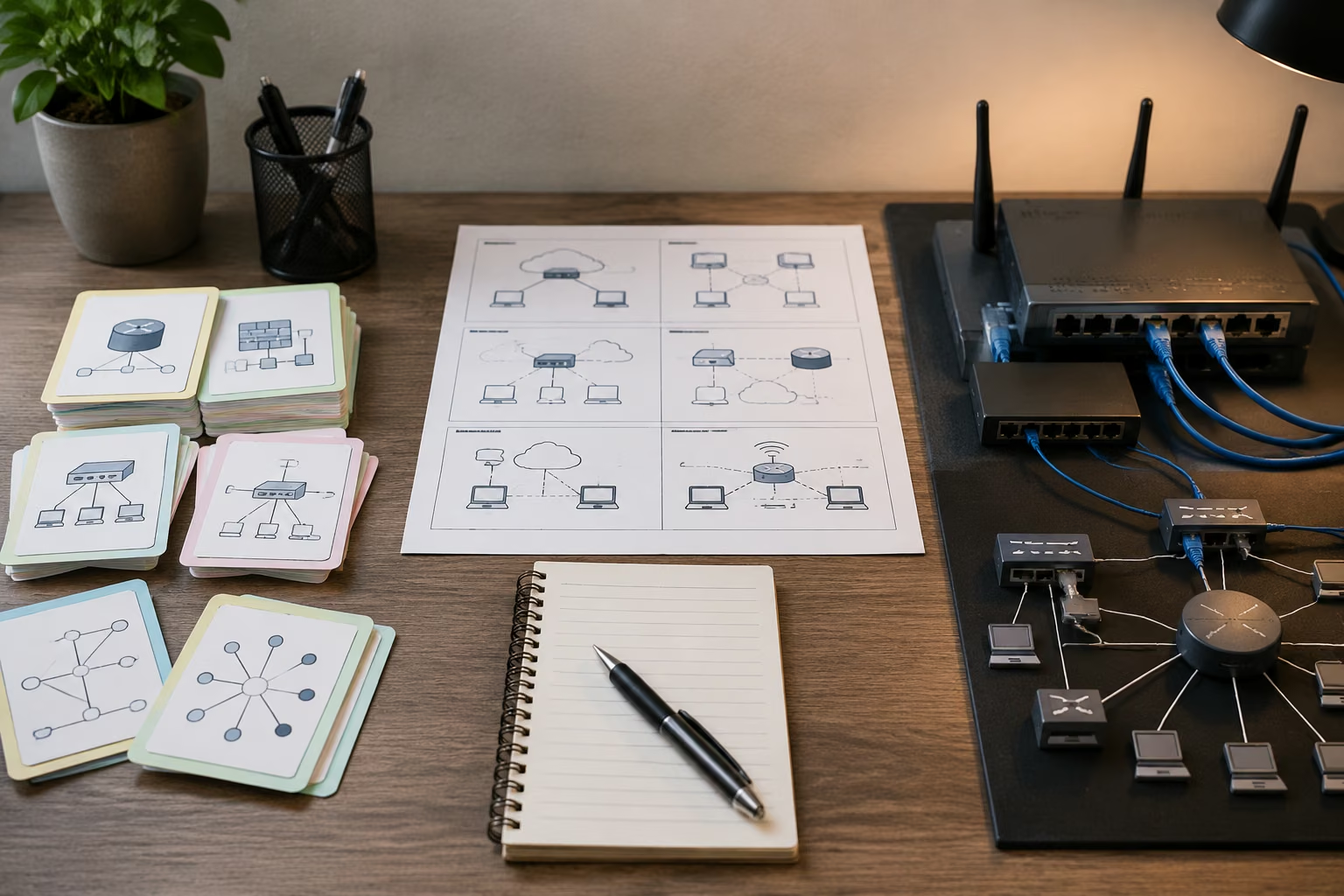
The supplied 9Tut premium pages describe a resource hub for learning ICND1 and ICND2. The pages organize practice into topic quizzes, composite quizzes, new-question sections, and simulator exercises. This guide focuses only on the resource scope and navigation documented in those saved pages.
What the supplied 9Tut premium resource pages cover
The welcome page states that premium members can access resources for learning ICND1 and ICND2. It describes flash-based questions for checking knowledge before each topic and provides links to the tests through the right-side menu.
The page separates the material into ICND1 and ICND2 resource groups. Each group includes specific topic-question collections and a set of new-question sections. The ICND1 group lists three parts of its ICND1v3 new questions, while the ICND2 group lists eight parts of its ICND2v3 new questions.
ICND1 and ICND2 resource groups
For ICND1, the page lists topic collections such as Basic Questions, Router Questions, DHCP Questions, Access list Questions, NAT/PAT, OSI & TCP/IP Model, Troubleshooting, TCP & UDP Questions, Switch Questions, IP Address, IPv6 Questions, Subnetting, VLAN Questions, IP Routing, OSPF Questions, Security Questions, Wireless Questions, and Drag and Drop.
For ICND2, the listed collections include Access list Questions, WAN Questions, OSPF Questions, Port Security Questions, VLAN Questions, PPP Questions, PPPoE Questions, DMVPN Questions, MPLS Questions, HSRP Questions, EIGRP Questions, VTP Questions, STP Questions, QoS Questions, RSTP Questions, IP Routing Questions, BGP Questions, IP SLA Questions, Security Questions, and Drag and Drop.
These lists function as a navigation map for the saved resource hub: ICND1 and ICND2 are presented as separate groups, and each group contains multiple topic-specific entries rather than one undifferentiated quiz.
How the topic quizzes are organized
The welcome page describes the topic practice as flash-based questions intended to check knowledge before each topic. It directs readers to the relevant test links through the right-side menu.
The ICND1 entries cover foundational and topic-specific areas including routing, switching, subnetting, troubleshooting, security, and wireless. The ICND2 entries cover areas including OSPF, EIGRP, BGP, VLANs, WAN, MPLS, troubleshooting, and security.
Using the topic lists as a navigation guide
To use the page as a navigation guide, start with the ICND1 or ICND2 group that matches the resource you are trying to locate. Then select the topic-specific entry corresponding to the area you want to practice. The source presents these collections as separate links, so readers can navigate to a particular topic instead of treating the entire resource list as a single quiz.
The page also directs readers to the new-question sections separately. ICND1 has three listed new-question parts, and ICND2 has eight listed new-question parts. The page specifically notes that ICND1 and ICND2 candidates should review the new-question links as well as the exam-question collections shown in the right-side menu.
What the composite quizzes contain
The ICND2 Composite Quizzes page states that it has 15 composite quizzes for the ICND2 200-105 exam. Each composite quiz contains 50 questions covering all topics of that exam.
The questions are selected randomly from the pool of specific topic quizzes. Because of that selection method, some questions can be repeated among the composite quizzes. The page presents repetition as an opportunity to practice a question more than once.
The same page describes the composite quizzes as practice intended to give learners a feeling for the real exam. It also emphasizes understanding the concept behind each question rather than memorizing answers.
Relationship between topic quizzes and composite quizzes
The source recommends completing the specific topic quizzes carefully before taking the composite quizzes. This establishes a sequence within the documented resource structure: topic quizzes provide the specific-topic practice pool, while composite quizzes draw questions from that pool across the exam topics.
The source separately warns that the composite quizzes may not include newer questions listed in the ICND2v3 new-question sections. Those newer questions should therefore be practiced separately according to the page's guidance.
Where the simulators fit
The welcome page lists three ICND1 simulators: the Show Configuration Simulator, the Security Testlet Simulator, and the DHCP Simulator. It lists three ICND2 simulators: the EIGRP Troubleshooting Simulator, the OSPF Neighbor Simulator, and the GRE Multilink Simulator.
The page provides interface guidance for using a simulator. It describes three buttons on the right-hand side: a question button and two device buttons. The question button is labeled “Q,” while the device buttons are labeled “R1-4” and “R5-6” in the example described by the page.
Simulator navigation described by 9Tut
The page explains that the device buttons provide access to the command-line interfaces of the simulated routers. After selecting a device control, the user can type commands into the corresponding text boxes to obtain information about the routers shown in the simulator.
The page also describes a “Show Questions” button on the left-hand side of the simulator. It instructs users to select that button to open the questions for the simulator.
This makes the documented simulator flow distinct from the topic-quiz flow: the topic lists point readers toward subject-specific question collections, while the simulator interface provides controls for opening questions and accessing simulated device command-line interfaces.
Limits of the supplied resource documentation
The supplied pages document ICND1 and ICND2 resources, including historical page notices and discussions associated with the saved pages. They do not, by themselves, establish the current applicability, availability, accuracy, or maintenance status of those resources.
The saved pages also do not establish independent certification requirements, general CCNP instruction, third-party training enrollment, product comparisons, guaranteed exam preparation, or guaranteed exam results. This article therefore remains limited to the resource organization and simulator guidance explicitly documented in the supplied pages.
Keep reading

Compare CCNP Collaboration Training Options by Coverage, Audience, and Access Model
Compare the supplied CBT Nuggets and LinkedIn Learning CCNP Collaboration training options by stated coverage, learner audience, and access model.

CCNP Training Programs: Scope, Labs, and Enterprise-Network Focus
Compare the supplied CCNP training descriptions by enterprise-networking scope, lab learning, delivery format, and concentration-exam preparation.

CCNP Salary Context: Career Roles and Reported Pay Figures
Explore the roles associated with CCNP Enterprise and the role-specific salary figures reported by the supplied career-path page, including factors that affect pay.